
AVStore · Room-first buying guide · Pune & Mumbai experience centres
Almost every tower speaker enquiry we get starts the same way: a photo of a living room, a budget, and a shortlist copied from a review site written in the UK.
The reviews are usually fine. The problem is that they were written for a carpeted room with drywall and a garden, and you are buying for a 3BHK with vitrified tile, RCC walls, a glass balcony door and a sofa that has to sit where it sits. That room changes the answer more than the speaker does.
So here is the version we actually use with customers: how to work out whether a tower belongs in your room, what to do about hard surfaces, where to put them, and what each budget genuinely buys in India today.
The short answer: yes, when the room is ready
A well-matched pair of floorstanding speakers, given space and driven properly, produces scale and physical presence that smaller speakers work hard to imitate. Voices sit at a natural height, drums and film effects carry weight, and the whole presentation feels unforced.
Put the same pair in a small, hard, furniture-constrained room and those strengths turn into the problem. Bass thickens, reflections smear detail, and you spend six months turning the volume down.
The best speaker is not the largest one that fits the budget. It is the one that suits the room.
What a tower does better than a bookshelf
A taller cabinet gives the designer more internal volume and more room to split the frequency range across dedicated drivers, typically a tweeter for detail, a midrange for voices, and one or more woofers for bass. That extra volume buys deeper bass extension and more dynamic headroom before the speaker starts to strain.
There is a second, less obvious advantage. Because the bass comes from the same cabinet as everything else, the presentation can feel more coherent than a satellite-plus-subwoofer arrangement that has been set up carelessly. Set up carefully, though, that gap narrows a long way, which is the point of the comparison further down.
Room size for floorstanding speakers: the first filter

Around 25 m² is a useful starting point for considering towers, not a cutoff.
Around 25 m² is a useful threshold, and it is a starting point rather than a rule. An open-plan 22 m² hall that runs into the dining area can need more output than an enclosed 28 m² room. Ceiling height, listening distance and how much soft furnishing you own all change the acoustic volume.
- Under about 18 m² - a bedroom or study. Stand-mounts from the bookshelf range, and a subwoofer only if you need one.
- 18-25 m² - a compact 2BHK hall. A slim tower can work: Polk T50 at ₹37,000, ELAC Debut F5.2 at ₹87,900 or DALI Oberon 5 at ₹1,25,000. Often a bookshelf plus subwoofer is cleaner.
- 25-40 m² - a typical 3BHK living room. Tower territory: Q Acoustics 3050i at ₹1,14,900, DALI Oberon 7 at ₹1,75,000, SVS Prime Tower at ₹2,20,000.
- 40 m² and above, or a villa living room - bigger cabinets earn their keep: Dynaudio Emit 30 at ₹2,80,000, DALI Opticon 6 MK2 at ₹3,35,000, B&W 704 S3 at ₹5,05,000.
Why Indian rooms change the answer
Most urban Indian homes are reflective. Vitrified tile or marble underfoot, plastered RCC walls, a large glass balcony door, a television on a hard surface and not much fabric anywhere. Sound reflects strongly in a room like that, which can make the presentation brighter and less defined, while walls and corners can reinforce bass unevenly.
This does not rule out towers. It means placement and bass alignment deserve more attention, and that a few soft surfaces do more good than an equipment upgrade.
| Surface | What it does | What helps |
|---|---|---|
| Marble, granite or vitrified tile | Reflects mid and high frequencies straight back at you | A dense rug between the speakers and the sofa |
| Glass balcony doors | Creates bright, early reflections | Full-length curtains, closed when listening |
| Bare parallel walls | Flutter echo and a hard tonal balance | Bookshelves, art, fabric, anything irregular |
| Corners and the rear wall | Reinforces bass unevenly | Move speaker and seat in small steps |
A dense rug between the speakers and the sofa, full-length curtains you actually close when listening, a fabric sofa and a filled bookshelf will change a room more than most people expect. None of it requires the living room to look like a studio.
Floorstanding speaker placement: a layout you can measure

Start with geometry, then move one thing at a time and listen.
Start with 60 to 90 cm between the speaker and the wall behind it, where the room allows. Rear-ported cabinets generally want more room to breathe; some front-ported and sealed designs sit closer to a wall happily. The manufacturer's guidance for your specific model always wins over a general rule.
Angle each speaker slightly toward the main seat. A little toe-in can tighten the centre image. Adjust the angle by ear, as the effect on treble balance varies by speaker. Keep both the speakers and the listening seat away from exact room midpoints, then adjust in 5 to 10 cm steps, changing one variable at a time.
On stone floors, don't place bare spikes directly on the surface. Most towers ship with metal spikes intended for carpet. Use the supplied rubber feet or proper spike cups to protect marble, tile or granite. Isolation can reduce vibration passing into the slab, but nothing stops bass reaching your neighbours through a shared wall.
Leave service space too. A speaker that blocks a balcony door or a walkway gets pushed into a worse position within a month, and daily usability is part of good system design.
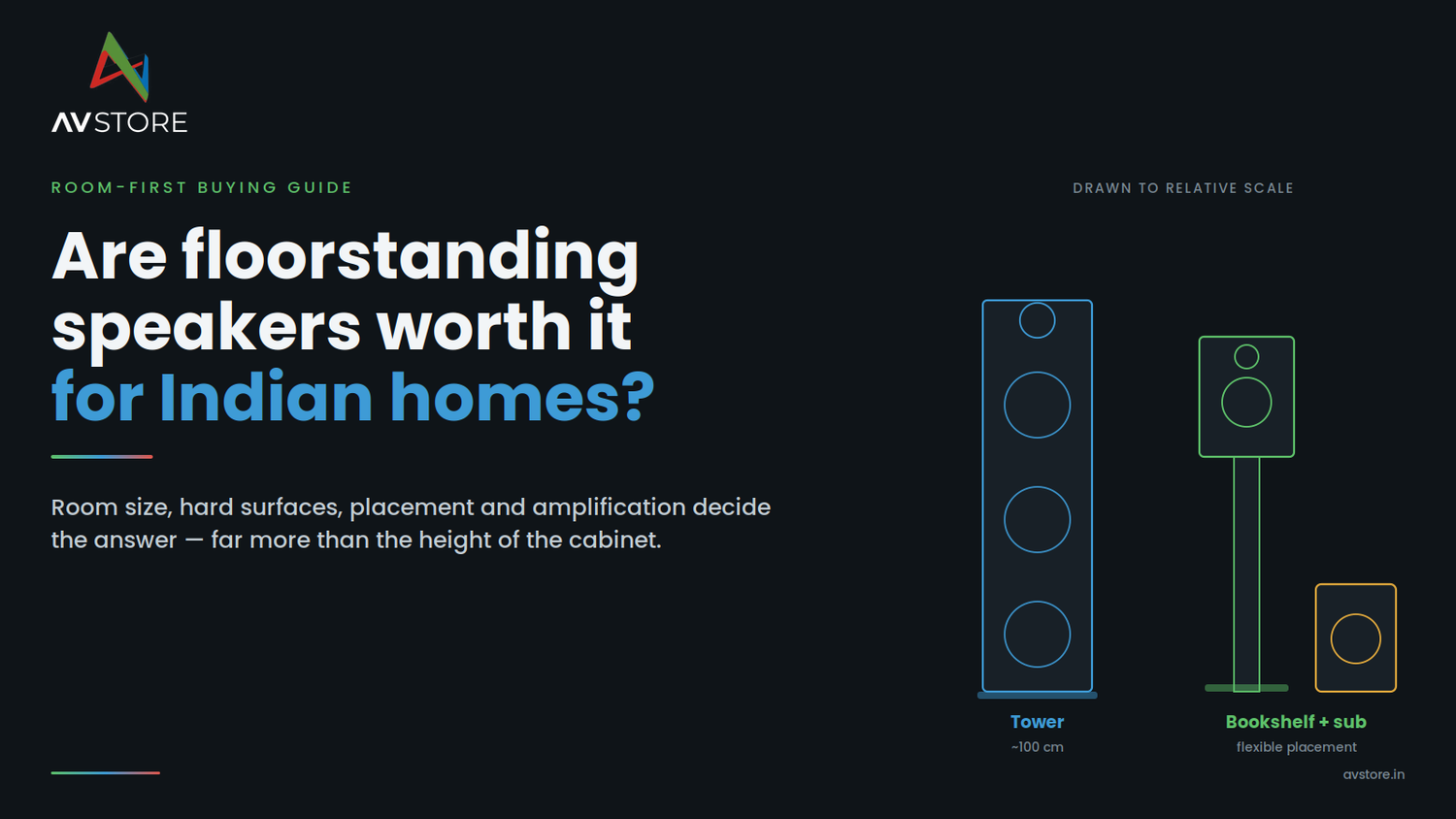
Floorstanding versus bookshelf and subwoofer

In many apartments, splitting the bass from the stereo pair is the more accurate route.
A good bookshelf speaker on a proper stand, paired with a carefully placed subwoofer, is not the budget option. In a hard-surfaced flat it is frequently the more accurate one.
The reason is simple: stereo imaging and bass almost never want the same position in a room. The main speakers can go where voices lock into the centre and the soundstage opens up. The subwoofer can go where the low frequencies measure most evenly, independently of where the main speakers image best. A tower forces both jobs into one location, and in a small reflective room that location is usually a compromise.
If a subwoofer is in the plan anyway, as it usually is for a serious home cinema system, compare both routes in the actual room before deciding.
Floorstanding speaker price in India: what each budget buys

Prices are current AVStore retail per pair and move with stock and exchange rates. Below are the twelve we most often shortlist, three per tier.
Under ₹1,00,000: a genuine first tower system
Polk T50 - ₹37,000. The cheapest way into a real tower. Forward and lively, happiest with films and rock, and forgiving of a modest AV receiver.
Emotiva Airmotiv T-Zero - ₹80,000. A slim cabinet with a folded-ribbon tweeter, so treble stays clean at volume. Good in a narrow 2BHK hall.
ELAC Debut 2.0 F5.2 - ₹87,900. The even-handed one. Nothing exaggerated, which makes it safer in a hard-surfaced room that already adds brightness.
₹1,00,000 to ₹2,00,000: the sweet spot for most 3BHK living rooms
Q Acoustics 3050i - ₹1,14,900. Warm, easy and unfatiguing. The one to pick if your room is tiled and glassy and everything else sounds too bright in it.
DALI Oberon 5 - ₹1,25,000. Slim, open and quick. Rear-ported, so give it room to breathe off the back wall.
DALI Oberon 7 - ₹1,75,000. Twin 7-inch woofers and genuine room-filling bass. Wants 25 m² or more. In a small hall it will overwhelm the room.
₹2,00,000 to ₹4,00,000: serious full-range performance
SVS Prime Tower - ₹2,20,000. Built for films. Unflustered when the soundtrack gets busy, and it takes a subwoofer crossover gracefully.
Revel Concerta2 F36 - ₹2,49,980. Neutral and measurement-led. Voices sit exactly where they should, which makes it an excellent cinema front.
Dynaudio Emit 30 - ₹2,80,000. The music-first pick. Dense, textured midrange that rewards acoustic material, and a demanding load, so budget the amplifier.
Above ₹4,00,000: dedicated rooms and long-term systems
Revel Performa3 F206 - ₹4,09,980. Refined and wide-dispersion, staying composed off-axis, useful when the sofa seats three and only one seat is central.
B&W 704 S3 - ₹5,05,000. Continuum midrange and real insight into detail. Revealing enough to show you a tired amplifier or a bright room.
KEF LS60 Wireless - ₹6,69,900. Active: speakers, amplification and streaming in one. Slimmest footprint here, at the cost of upgrade flexibility.
Also in stock
Polk ES50 ₹85,000, ELAC F6.2 ₹1,09,900, Emotiva T1+ ₹1,24,999, Acoustic Energy AE305 ₹1,25,000, Q Acoustics Concept 40 ₹1,39,900, ELAC DFR52 ₹1,49,900, RBH R-55 from ₹1,79,990, Emotiva T2+ ₹1,90,000, Revel F35 ₹2,19,980, Emotiva T3+ ₹3,10,000, Dynaudio Emit 50 ₹3,25,000, DALI Opticon 6 MK2 ₹3,35,000, SVS Prime Pinnacle ₹3,40,000, SVS Ultra Tower ₹5,00,000, Revel F208 ₹5,49,980, Dynaudio Evoke 30 ₹6,40,000, Q Acoustics Concept 500 ₹6,74,900, B&W 703 S3 ₹8,20,000.
Matching an amplifier to floorstanding speakers

Cabinet size tells you nothing about how hard a speaker is to drive.
Check sensitivity, nominal impedance, minimum impedance and the manufacturer's recommended amplifier range. A capable tower on an amplifier that runs out of current sounds flat, hard or loose at exactly the moment the music gets demanding, and most people blame the speakers.
For music-first systems, look at integrated amplifiers. For a room doing both films and music, a capable AV receiver handles surround channels, bass management and room correction in one box. Demanding towers in a large room may want separate power amplification.
As a starting point for a balanced system budget, allowing roughly a third to half of the speaker spend for amplification is reasonable, but impedance, sensitivity, room size and listening level matter more than the ratio. Do not leave speaker cable as an afterthought.
Room correction is genuinely useful for smoothing bass and integrating a subwoofer. It cannot make a speaker physically fit, restore a soundstage blocked by a cabinet, or undo strong early reflections. Placement first, calibration second.
Do towers always need a separate amplifier?
No. An active system such as the KEF LS60 Wireless at ₹6,69,900 puts the speakers, amplification and streaming platform into one coordinated design. Fewer boxes, less rack space, and the manufacturer controls the amplifier-to-driver relationship precisely. In a design-led living room that matters.
The trade-off is flexibility. With passive speakers you can change the amplifier, the streamer or the source independently over the years. With an active system those decisions are made for you. Neither is better in the abstract. See the active stereo range and decide which kind of ownership suits you.
A five-step check before you buy
- Measure the usable room. Width, length, ceiling height, listening distance, and any opening into the dining area or a corridor.
- Map real placement. Mark the TV unit, doors, the balcony path and the maximum wall clearance you can genuinely keep, not the one you hope for.
- Audit the surfaces. Note stone floor, glass, bare walls, curtains, rugs, fabric seating and large cabinets.
- Choose the format. Passive stereo, home cinema with a centre channel, bookshelf plus subwoofer, or an active system.
- Audition with your own music. Voices, acoustic instruments, something dense, and a familiar film scene. Listen for bass evenness, a solid centre image, and whether you want to keep listening after twenty minutes.
Take photos of the room and the wall the system will sit against. They let an AVStore specialist spot placement and cabling problems while the shortlist is still cheap to change.
Frequently asked questions
Are floorstanding speakers good for a small room?
Usually not the large ones. Below about 18 m² a tower will overload the room with bass long before it reaches its potential, and you end up listening quietly to avoid it. A slim tower can work in an 18-25 m² hall, but a bookshelf pair with a subwoofer often sounds cleaner and gives you far more placement freedom.
How far from the wall should floorstanding speakers be?
Start at 60 to 90 cm from the wall behind the speaker where the room allows, with a gentle toe-in toward the listening seat. Rear-ported designs generally need more clearance than front-ported or sealed ones. Move in 5 to 10 cm steps and change one thing at a time.
Do I need a subwoofer with floorstanding speakers?
For music in a well-matched room, often not, that is the point of a tower. For home cinema, a subwoofer is still worth having, because film effects go deeper than most towers reach and bass management lets the main speakers work less hard.
Are towers or bookshelf speakers better for Indian apartments?
It depends on the room rather than the format. Indian apartments tend to be hard-surfaced and layout-constrained, which favours a bookshelf pair plus a subwoofer you can place independently. In a larger living room with space around the speakers, a tower is excellent.
What amplifier do I need for floorstanding speakers?
Check the speaker's sensitivity and minimum impedance rather than the headline 8-ohm figure, and budget roughly a third to a half of the speaker spend. An integrated amplifier suits music-first systems; an AV receiver suits mixed film and music use; separate power amplification suits demanding speakers in large rooms.
Can I use spikes on a marble or tile floor?
Use the supplied rubber feet or proper spike cups instead. Spikes are designed to pierce carpet and will scratch stone, and the cabinet can slide. Isolation helps reduce vibration into the slab but will not stop bass travelling to a neighbouring flat.
Do you deliver and set up outside Pune?
Yes. AVStore ships across India with GST-compliant invoicing, and our team can advise on placement remotely from your room dimensions and photographs.
The verdict
If your room offers sensible placement, some acoustic softness and enough listening distance, floorstanding speakers deserve serious consideration. Scale, dynamics and full-range coherence of that kind are difficult to imitate.
If the room is small, hard or constrained, a well-chosen bookshelf pair and a properly placed subwoofer will sound cleaner every single day. That is not settling. That is system matching.
Start with the room, shortlist the format, match the amplifier, then audition. That order is far more reliable than buying the largest tower the budget allows.
Find the right floorstanding speakers for your room
Browse the full floorstanding speaker range , or bring your room dimensions to our experience centre at 21 Akshay Complex, Dhole Patil Road, Pune 411001, open Monday to Saturday, 11am to 8pm.
If you are elsewhere in India, talk to our team . We will tell you honestly whether your room wants a tower or something smaller and better placed.

Leave a comment
All comments are moderated before being published.
This site is protected by hCaptcha and the hCaptcha Privacy Policy and Terms of Service apply.