
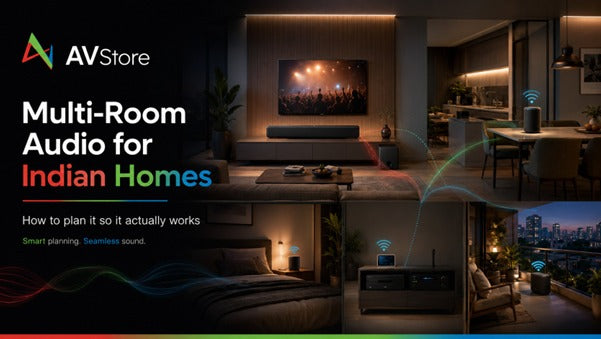
Multi-room audio for Indian homes: How to plan it so it actually works
Clients usually call us about three weeks after an install, unhappy, convinced the speakers are faulty. They almost never are. In nine cases out of ten, the speakers are fine, and the house is the problem, or more precisely, the network inside the house is the problem. That is the part nobody budgets for, and nobody plans.
When multi-room is done properly, you stop noticing it. You start a song in the kitchen, walk into the living room, and it is already playing there. Group two rooms, drop one, send something else out to the balcony. After the first week, nobody in the family thinks about how any of it works. That is the whole idea.
Most guides on this subject are written for a house in London or California. They assume open floor plans, drywall, and a garden. That is not a 3BHK in Baner with a router hidden behind the TV unit, load-bearing concrete between every room, and a modular kitchen that eats signal for breakfast. Here is how we plan these systems for homes that actually exist here.
Multi-room audio in a 2BHK or 3BHK: it should not be a luxury in India
I understand how the category got its reputation. The demonstrations usually involve a villa, eight zones, and a rack in the utility room. Plenty of our clients do exactly that, and it is wonderful. But an assumption has quietly attached itself to all of it: that you need square footage before any of this is worth doing, and that assumption is wrong. It costs people years of not enjoying their music.
Two speakers that talk to each other is a multi-room system. A 2BHK in Kothrud with one speaker in the kitchen and one in the living room is a multi-room system, and it is the single most common configuration we install. The kitchen and the living room are where Indian families spend their evenings. Everything else is expansion.
These platforms are built to be added to, one box at a time. Buy one speaker. Live with it for a few months. Add the second when it makes sense, the third whenever you feel like it. Nothing has to be bought together, and nothing has to match. In a smaller flat you are also starting from an easier position: fewer walls in the way, less distance to cover, and often no need for a mesh network at all if the router is decent and reasonably placed.
Where a compact home does need thought is placement, because there are fewer good spots and more competing noise from the road, the kitchen, and the fan. That is a conversation with someone who has done it before, not a budget problem.
Wi-Fi, mesh routers and RCC walls: the network comes before the speaker

Almost every complaint we handle traces back here. Music cuts out when the microwave runs. Two rooms work, and three do not. The bedroom lags half a beat behind the hall, so you stand in the corridor listening to a faint echo of yourself, which is nobody's idea of immersive.
Many Indian apartments use RCC construction: dense concrete walls, steel reinforcement and thick slabs. Structurally excellent, but tough on Wi-Fi, particularly higher-frequency bands such as 5GHz. A single router in one corner of the hall will cover the hall and maybe the room next to it, then quietly give up somewhere around the kitchen. Instagram still loads perfectly, which is exactly why people assume the network is fine. Holding four rooms in tight sync is a far harder job than loading a video.
The answer is a mesh system, and once you understand the problem it stops sounding like an upsell. Two well-placed nodes are often enough for a typical 3BHK. Duplexes, villas and independent houses usually want three or four. If you are replacing the router anyway, buy a Wi-Fi 6 or Wi-Fi 7 mesh, because the speakers are joining a network that already carries phones, laptops, televisions and cameras. And if there is any structured cabling in the house, run the nodes on wired backhaul.
Plan the network before you plan the speakers. It is not background infrastructure. It is as much a part of the system as anything with a tweeter in it.
Sonos vs Denon HEOS vs B&O: choose the ecosystem first, the speakers second

The platform decision outlives the speaker decision. Every soundbar, amplifier and streamer you add over the next ten years has to live inside it. This is worth a week of thought and a proper listening session.
Sonos multi-room speakers, for most homes
Sonos is what we put in front of most people, and for a first system it is not a close call. The reason is unglamorous, and it is the right reason: it stays in sync, and it keeps working. Rooms group with a tap. A new speaker joins the house in a few minutes. Nobody in the family needs to be taught anything.
The range is what makes it stick. An Era 100 handles a kitchen or a bedroom. Era 300 goes where you want spatial audio. Arc Ultra or Beam sits under the television, with Sub 4 or Sub Mini if the room needs weight underneath it. Move 2 and Roam 2 come out to the balcony and travel with you.
The two products people overlook are Sonos Amp and Sonos Port. The Amp drives passive speakers, including in-ceiling and outdoor pairs, which brings the terrace and the passage into the same app as everything else. Port takes an existing hi-fi system, amplifier and all, and pulls it onto the network without replacing a thing. That one solves a lot of arguments in homes where somebody already owns good gear.
You can start with one Era 100 in the bedroom and finish with the whole house running on one app. Very few people regret starting here.
Denon HEOS, especially where an AV receiver is involved
If the living room already has a Denon or Marantz AV receiver as part of a home theatre, or you are about to buy one, the HEOS ecosystem is the smarter route and it costs nothing extra to switch on. HEOS is built into the AV receiver range, so the receiver you bought for movies and TV shows becomes your first zone the day it is installed. Most owners have no idea it is sitting there unused.
From that point it extends outward. The newest Denon Home 200, 400 and 600 speakers support Dolby Atmos Music, and the long-running Home 150, 250 and 350 are still doing quiet, reliable work in a lot of homes. There is a Home Sound Bar 550, a Home Subwoofer, and a Denon Home Amp that drives passive in-ceiling and outdoor speakers. The Denon Home speakers also play hi-res files properly, FLAC and WAV up to 24-bit/192kHz plus DSD, which matters if you have spent years building a library rather than renting one. A huge advantage of the Denon HEOS systems is the USB port, where you can plug in your portable hard disk or USB drive containing your personal music collection and play it back in all or any of the zones.
This is the route for homes where the theatre is the centre of gravity and the rest of the house grows out from it. One app, one brand, no negotiation between systems.
A note on what is missing from this list: MusicCast appears in many international multi-room guides, but given the current product availability and ecosystem options in India, it isn't one of the platforms we typically recommend for a new whole-home installation.
B&O, Bowers & Wilkins and Devialet: when the speaker has to be furniture
For a certain kind of home, the speaker is chosen the way a lamp or a chair is chosen. It has to be right in the room before anyone talks about drivers. All three of these brands run their own multi-room layer, so you are not giving up whole-home playback to get an object you actually want to look at.
Bang & Olufsen has Beolink Multiroom. Beosound A5, Balance, Level and Emerge, the Beolab range, and Beosound Theatre all link across it. Because they also carry AirPlay 2 and Chromecast, a B&O piece can sit in the drawing room and still play alongside more ordinary speakers elsewhere in the house. If the client is choosing with an interior designer in the room, this is usually where we end up.
Bowers & Wilkins groups Zeppelin Pro Edition, Panorama 3 and the Formation series through the Bowers & Wilkins Music app, with Tidal, Qobuz and the rest built in, plus AirPlay 2 and aptX Adaptive. A Panorama 3 under the television and a Zeppelin or Formation Wedge in the bedroom makes a genuinely good two-zone system, and it sounds like B&W, which is the reason anyone buys it. One thing is certain: the sound you hear from these speakers will upgrade your music listening experience, and you will use these as a benchmark for sound quality.
Devialet runs its Phantom speakers through the Devialet app, with AirPlay 2, Spotify Connect and Roon, and on the current Phantom Ultimate models, Google Cast and Tidal Connect as well. Phantoms do things with bass that a speaker that size has no business doing, and clients who hear one rarely un-hear it. One practical note from installs: Devialet recommends wiring over Ethernet once you go past roughly six Phantoms, so if a house is heading in that direction, cable it while you can.
AirPlay 2 and Google Cast: the neutral layer underneath
Nearly everything above supports AirPlay 2, Google Cast, or both, and that neutral layer is what lets a mixed house function. Sonos in the kitchen, B&O on the console, a Denon receiver in the theatre. Grouping across brands will never be as tight as grouping within one, so treat it as useful flexibility rather than the plan itself.
For an Android household working to a tight budget, Cast on its own is often enough to begin with. JioSaavn, YouTube Music and Spotify all cast natively. Tap the icon, pick the room, done.
Multi-room audio room by room: think in zones, not in speakers

Rooms do not deserve equal budgets. Work out what each one is for before you spend anything, or you will overspend on the room nobody sits in, and underspend on the one everybody does.
The living room sets the standard for the house. That might be an AV receiver with passive speakers, a soundbar with a subwoofer behind it, or a good wireless pair. If it is doing double duty for films and gaming, pick a platform that handles cinema and music without you switching apps every evening.
The kitchen is the most underestimated room in an Indian home. Between cooking, chai, cleaning up and people drifting in and out, it gets more hours of audio than the living room in most houses we visit. What it needs is clarity at low volume, a connection that holds, and a spot away from steam, oil and heat. One compact speaker does the job, provided the Wi-Fi genuinely reaches it.
The bedroom is about convenience, not output. Sleep timers, a physical volume control you can find in the dark, voice control if that suits you. Nobody wants to unlock a phone and open an app at midnight to turn something down.
The pooja room gets skipped by every international guide and used by almost all our clients. Morning aarti, bhajans, or quiet background music, on a schedule if you like it that way. A small speaker, hands-free control since your hands are busy, and sensible placement. Volume was never the requirement here.
Balconies and terraces are proper living spaces in Indian homes, not leftovers, so they deserve real planning. A portable speaker covers a small balcony. Terraces and gardens want something installed and weather-rated. Check coverage before you buy anything, because balconies sit at the far edge of the flat, which is precisely where the router gives up. This is where a well-placed mesh node earns back its cost.
If you are renovating anyway, in-ceiling speakers are worth considering for the kitchen, the dining area and the passages. Nothing on the counter, nothing to dust around, even coverage overhead. Run them off a Sonos Amp or a Denon Home Amp, and they behave like any other zone in the app.
Cat6 and structured wiring: wire what you can while the walls are open

The most reliable systems we have installed are wired at the core and wireless only where a cable was genuinely impossible.
If your home is under construction or mid-renovation right now, this is the one window you get. Run Cat6 to the AV rack position, the study, the master bedroom, any media room, and to wherever the mesh nodes will eventually sit. During construction, this costs very little. Retrofitting it into a finished RCC flat is a different job with a different bill, and it usually means the false ceiling comes down.
So raise it with your architect, contractor or interior designer now, not after the ceiling is closed. A handful of planned network points today saves you years of Wi-Fi that almost works.
For villas and duplexes, go further. Professionally installed wired access points beat leaning entirely on wireless mesh backhaul across that much area, every time.
Streaming services for multi-room audio in India, in practice
Spotify Connect is supported nearly everywhere and is what most Indian households actually use day to day. YouTube Music and JioSaavn go through Google Cast. Apple Music runs over AirPlay 2 from an iPhone, iPad or Mac. Tidal and Qobuz turn up natively inside the Sonos, HEOS, Bowers & Wilkins and Devialet apps, which is the point at which a hi-res subscription starts justifying itself.
The systems that survive a family are the ones that speak several protocols at once, because your household is not going to standardise on one phone or one app. Look for AirPlay 2, Google Cast, Spotify Connect, and an Ethernet port on anything that is never going to move.
Common multi-room audio mistakes: what goes wrong
- Assuming Bluetooth and multi-room are the same thing, when they are not even related
- Mixing platforms without knowing what breaks, which is usually grouping and sometimes the whole app
- Putting a speaker where steam, cooking oil or afternoon sun will quietly kill it
- Skipping Cat6 during a renovation you are never going to repeat
- Spending on the guest bedroom and saving on the kitchen
- Expecting one router to cover an entire RCC flat or villa
Almost every one of these arrives dressed as a product problem. They are planning problems that showed up late.
How to start planning your multi-room audio system
Walk your own house first. Note which rooms music actually happens in and how loud it needs to be in each. Check the Wi-Fi in every one of them, balcony included. Then choose the ecosystem that fits the phones, the streaming apps, and the AV gear already living in your home. Speakers come last, and by then they are the easy part.
Done properly, you stop being aware that there is a system at all. Music starts, stays in sync, and follows you from room to room without asking anything of you.
If you want to hear the difference between these platforms before you commit to one, come and listen to them side by side. Our experience centre is at 21 Akshay Complex, Dhole Patil Road, Pune 411001, open Monday to Saturday, 10:30 am to 7:30 pm. Bring your floor plan if you have one, and we will tell you honestly whether you need two speakers or ten. If you are elsewhere in India, contact our team to plan the system remotely and work with your architect or installer to get the best solution and genuine products.

Leave a comment
All comments are moderated before being published.
This site is protected by hCaptcha and the hCaptcha Privacy Policy and Terms of Service apply.