
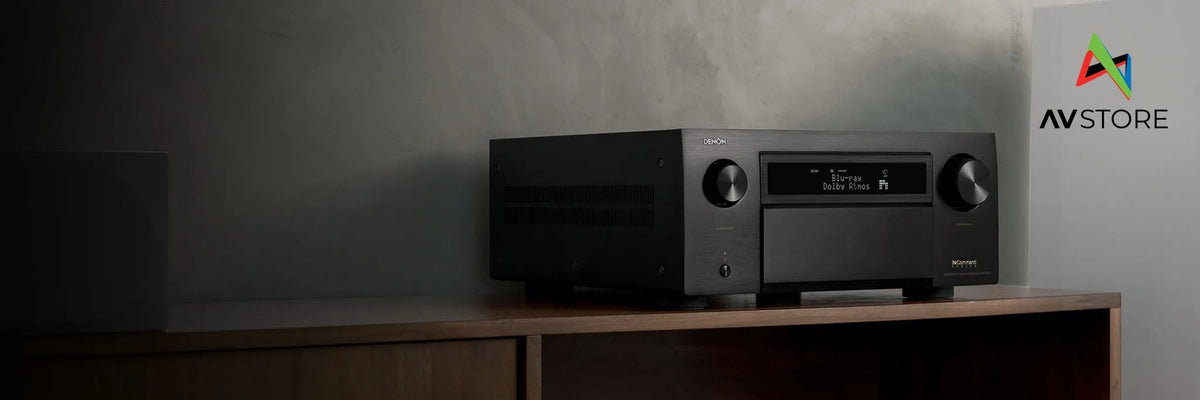
Want surround sound for films, clearer dialogue and music through the same speakers? An AV receiver connects your TV, streaming devices and games console to a speaker system, so everything works together. Here’s how to find one that fits your room and the way you listen.
Start with your room and the way you listen
Start with two things: how many speakers will fit in your room, and what devices do you want to connect? Choose an AV receiver that can power those speakers and has enough HDMI ports for devices like your gaming console and streaming box.
Before choosing a receiver, check how far you sit from the front speakers, where surround speakers could go, and whether you can run wires for ceiling speakers.
Set a budget for the whole setup, including speakers, a subwoofer, cables and installation. If you’re unsure what you need, contact our team for help choosing an AV receiver that suits your room and budget.
Quick receiver comparison
Start with the speaker layout you want to use. These rounded receiver-only budget bands are planning guides based on AVStore listings checked on 5 November 2026; prices, finishes and availability can change. Speakers, subwoofers and installation cost extra.
| AVR budget | Example receiver | Layout | Use case |
|---|---|---|---|
| ₹35,000–₹45,000 | Denon AVR-X580BT | 5.1 | Five speakers for TV, films and console gaming; no height speakers. |
| ₹55,000–₹65,000 | Denon AVR-S770H | 5.1.2 | Five surround speakers and two height speakers, with HEOS music streaming. |
| ₹70,000–₹80,000 | Denon AVR-X1800H | 5.1.2 | The same seven-speaker layout, with Audyssey MultEQ XT for setup. |
| ₹90,000–₹1 lakh | Denon AVR-X2800H | 5.1.2 | A seven-speaker setup with HDMI connections for both a TV and projector. |
| ₹1.2–₹1.5 lakh | Denon AVC-X3800H | 5.1.4 | Four height speakers, with nine speakers powered by the unit in total. |
| ₹2.5–₹3.5 lakh | Denon AVC-X6800H | 7.1.4 | Seven speakers around the room and four overhead, powered from one unit. |
The middle number is the subwoofer count. Powered subwoofers have their own amplifiers. The 5.1.2 examples use seven speaker amplifier channels; 7.1.4 uses eleven. Multiroom speaker assignments can reduce the channels available to the main room.
AV receiver vs stereo receiver vs processor and power amp
AV receiver: Connects your sources, decodes surround sound and powers several passive speakers. Choose this type for centre, surround and height speakers in a home cinema. Models sold as integrated AV amplifiers, such as the Denon AVC range, combine those cinema functions too; a radio tuner is not essential to the setup.
Stereo receiver: Powers two speaker channels for music and TV. The Denon DRA-800H and DRA-900H include HDMI switching and network music features, but do not power separate centre, surround or height channels.
Stereo integrated amplifier: Combines volume and source control with two-channel amplification. The Denon PMA models suit stereo listening; TV inputs, streaming and phono support vary by model.
AV processor: Handles source selection, volume and surround decoding, but needs separate power amplification for passive speakers. The Primare SP25 Prisma belongs here.
Power amplifier: Drives passive speakers from a processor or compatible preamp output. It does not replace HDMI switching or surround decoding. The Primare A35.8 and A35.2 belong here.
Choose your speaker layout
A 5.1 layout uses five speakers and one subwoofer. Add two height speakers for 5.1.2 Dolby Atmos. A receiver needs seven built-in amplifier channels to power that layout on its own. Some models can process more channels than they can power, so a larger layout may need a separate amplifier.
Check what you need to connect
Count the HDMI devices you use, like a console or streaming box, and leave a spare input if you plan to add another. If you use both a TV and a projector, check that the receiver can connect to both.
For gaming, make sure your console, receiver, TV and cables support the features you want, such as 4K at 120 Hz. If you watch through your TV’s built-in apps, HDMI eARC can send the sound back to your receiver. For music, check that the receiver works with your preferred streaming service.
Understand watts and speaker compatibility
Watts per channel describe amplifier output under stated test conditions. Compare ratings measured at the same speaker impedance, frequency range, distortion level and number of channels driven. For example, Denon rates the AVR-X1800H at 80W per channel into 8 ohms, across 20Hz–20kHz, with 0.08% distortion and two channels driven. That is not an 80W guarantee across all seven channels at once.
Speaker impedance, measured in ohms, describes the electrical load presented to the amplifier. Lower impedance can demand more current, so check the receiver’s supported range and the speaker manufacturer’s requirements. Speaker sensitivity, listening distance and volume also affect the power you need; a speaker’s watt rating alone does not tell you whether it is a suitable match.
Share the exact speaker models with AVStore before ordering. A powered subwoofer supplies its own bass amplification, but the receiver still needs compatible outputs and correct speaker settings.
How to split your system budget
For a new system, use 30% for the receiver, 50% for the passive speakers and 20% for a powered subwoofer as an initial planning exercise. This is our editorial starting point, not a fixed rule or a manufacturer requirement. Allow separately for cables, installation and any acoustic work; a projector or TV is outside this audio budget.
For example, a ₹2 lakh audio budget could mean ₹60,000 for the receiver, ₹1 lakh for the speakers and ₹40,000 for a subwoofer. This illustrates how to divide a budget, not a quotation for a complete system. Get an itemised proposal before deciding on products.
If you already own speakers and a subwoofer, the receiver can take a larger share of your new purchase budget. A 7.1.4 system needs eleven channels of amplification and more speakers, so quote the whole layout rather than applying the same split to every room.
Choosing a Denon receiver for your setup
The AVR-S770H, AVR-X1800H and AVR-X2800H all power seven speakers, so each can run 5.1.2 Dolby Atmos with a powered subwoofer. Decide which connections and setup tools you will actually use; none of these three powers a 7.1.4 layout on its own.
Denon AVR-S770H : Choose it for a single TV, five surround speakers and two height speakers when Audyssey MultEQ and HEOS cover your needs. Its six HDMI inputs give several video sources a place in the system.
Denon AVR-X1800H : Choose it when you want the same seven-speaker layout with Audyssey MultEQ XT. It has one HDMI monitor output, so plan it around a single display.
Denon AVR-X2800H : Choose it when you need two HDMI monitor outputs for a TV and projector, with Audyssey MultEQ XT. Those outputs serve the main room; they are not independent HDMI video zones.
For four overhead speakers, consider a nine-amplifier-channel unit such as the AVC-X3800H for 5.1.4. For 7.1.4 without an external power amp, plan around eleven built-in amplifier channels, as on the AVC-X6800H.
Multichannel home cinema receivers and AV amplifiers
The models below cover different ways to build a system, from two speakers for music and TV to a dedicated Dolby Atmos cinema. Linked model names open their AVStore product pages. Check with our team for current availability.
Denon
Denon AVR-X250BT
Build a straightforward five-speaker surround system for films. Bluetooth lets you play music from your phone through the same speakers. Five HDMI inputs give you room for a console, streaming box and other sources.
Denon AVR-X580BT
Set up a living room where gaming and films share the same screen and speakers. Its five powered channels cover the main surround speakers. Its HDMI output sends the picture to the TV while the receiver plays sound through your speakers.
Denon AVR-S660H
Use five speakers for surround sound and switch to HEOS when you want to play music. This suits a room where the TV setup doubles as the main music system. A built-in phono input also lets you add a compatible turntable.
Denon AVR-S670H
Connect the family’s console and streaming box to one system. It suits a surround layout with five speakers and no ceiling speakers. HEOS gives you a way to stream music without turning on the TV.

Denon AVR-S960H
Plan a living-room cinema with sound overhead. Its seven amplifier channels can power five speakers around the room and two height speakers. HEOS also lets the receiver play music as part of a compatible multiroom system.
Denon AVR-S970H
Use the main system for films and Zone 2 for music in a second room. Plan how you’ll assign the amplifier channels if you want both spaces to share the receiver. HEOS can also play music through compatible wireless speakers elsewhere in the home.
Denon AVR-S770H
Choose this for one TV and a 5.1.2 speaker layout when HEOS streaming and Audyssey MultEQ cover your needs. Its six HDMI inputs can connect your console, streaming box and other sources. The seven built-in amplifier channels can power five speakers around the room and two height speakers.
Denon AVR-X1700H
Bring console gaming and Dolby Atmos films together in one system. Its compatible HDMI inputs can pass 4K at 120 Hz to a suitable display. HEOS lets you switch from a film to a playlist through the same speakers.
Denon AVR-X1800H
Choose this for a seven-speaker cinema when you want Audyssey MultEQ XT to help tune the setup. Its six HDMI inputs and single HDMI monitor output suit one display with several sources. Use the seven powered channels for 5.1.2 Atmos or seven speakers around the room.
Denon AVR-X2700H
Plan a room with both a TV and a projector. Two HDMI outputs give you a way to connect both displays to the receiver. A moving-magnet phono input lets you add a compatible turntable to the system.
Denon AVR-X2800H
Choose this when the same room uses both a TV and projector. Two HDMI monitor outputs let you connect both displays to the main-room system, while Audyssey MultEQ XT helps with setup. Seven built-in amplifier channels support five speakers around the room and two overhead.
Denon AVR-X2900H
Use it as the hub for a cinema and gaming room built around a compatible 4K or 8K display. Dolby Atmos support gives you the option to plan height speakers. HEOS also gives you a way to use the system for music when you’re not watching anything.
Denon AVC-X3800H
Power five speakers around the room and four overhead from one unit. If you later expand to an eleven-speaker layout, add a separate two-channel power amplifier. Audyssey MultEQ XT32 helps tune the system after the speakers and subwoofer are in place.

Denon AVC-X3900H
Build a cinema around overhead effects. Its nine powered channels can run five speakers around the room and four overhead. HEOS makes it easy to use the same system for music when the screen is off.
Denon AVC-X4800H
Plan a dedicated cinema with subwoofers in several positions. Independent subwoofer outputs allow individual adjustment during setup. Audyssey MultEQ XT32 gives you a way to tune the system once the speakers and subwoofers are in place.
Denon AVC-X6800H
Use seven speakers around the room and four overhead. Its eleven amplifier channels can drive that layout without a separate power amp. A built-in moving-magnet phono input gives a compatible turntable a direct connection.
Denon AVC-A10H
Design a custom cinema around the room and seating positions. It has thirteen built-in amplifier channels for layouts with multiple height speakers. Audyssey MultEQ XT32 can help tune the system once the full speaker layout is installed.
Denon AVC-A1H
Plan a dedicated theatre around a large speaker layout from the start. Its fifteen powered channels can support nine speakers around the room and six overhead. Balanced XLR inputs give you a way to connect a compatible stereo source with balanced outputs.

Anthem


Anthem MRX 540
Set up five speakers and a subwoofer in a living room. Anthem Room Correction helps tune the system once the speakers are in place. Its five built-in amplifier channels cover the main speakers, while a powered subwoofer connects separately.
Anthem MRX 740
Plan five speakers around the sofa and two overhead. Its seven built-in amplifier channels can power that layout without a separate amp. Anthem Room Correction helps you adjust the sound once you’ve positioned the surrounds and height speakers.
Anthem MRX 1140
Plan a dedicated cinema with seven speakers around the room and four overhead. Eleven built-in amplifier channels let you run that layout from one unit. Anthem Room Correction helps tune the system around the seating area once installation is complete.
Arcam

Arcam AVR5
Use the same speakers for albums and films. Seven built-in amplifier channels give you room to plan a surround setup around the space you have. HDMI eARC can bring sound from a compatible TV back to the receiver.
Arcam AVR11
Bring a console and movie sources together on the same TV and speakers. HDMI 2.1 is useful when planning around a compatible gaming console and display. It can also decode a larger 7.1.4 layout if you add enough external amplification.
Arcam AVR21
Build a cinema in stages. It powers seven speakers on its own; add a separate power amp to use more of its supported speaker channels. The HDMI connections let video sources and surround playback share the same system.
Arcam AVR31
Use one receiver to process surround sound and drive the speakers. Its seven Class G amplifier channels can run five speakers around the room and two overhead. It can decode up to sixteen channels, with separate amplification needed for speakers beyond the seven it powers.
Marantz


Marantz CINEMA 70s
Fit seven powered channels into a living room with limited cabinet height. The slim chassis saves vertical space, but leave room for ventilation. Built-in HEOS lets you play music through the same speakers without using the TV.
Marantz CINEMA 50
Build a room around overhead sound. It can power five speakers around the seating area and four overhead. Audyssey MultEQ XT32 helps tune the system after the speakers are installed.
Marantz CINEMA 40
Build a cinema in stages. It powers nine speakers on its own; add a two-channel amplifier to use all eleven speaker channels it can process. Audyssey MultEQ XT32 gives you a way to recalibrate after you change the speaker layout.
Marantz CINEMA 30
Plan a room with space behind the seats and on the ceiling. The receiver can power seven speakers around the room and four overhead. Built-in HEOS lets you use the cinema speakers for music as well.
Primare

The SPA25 Prisma is an integrated home cinema amplifier with surround processing and built-in speaker amplification. Primare’s processor and separate power amps appear below.
Primare SPA25 Prisma
Use one integrated home cinema amplifier for films and music. It powers the speakers for movie night and streams music through the same system when the screen is off. Its nine built-in amplifier channels can power five speakers around the room and four overhead.
Onkyo
These models illustrate Onkyo’s home theatre range. Contact AVStore for current Onkyo availability.
Onkyo TX-NR7100
Plan a cinema with five speakers around the room and four overhead. This nine-channel receiver can power that layout. It also includes Dirac Live Room Correction to help tune the sound to the space.
Onkyo TX-RZ50
Tune the system after you’ve positioned your speakers. The TX-RZ50 includes Dirac Live Room Correction to help adjust the sound to the room. It can process a 7.2.4 layout with an added stereo power amplifier for two of the speakers.
Onkyo TX-RZ70
Use eleven built-in amplifier channels for a dedicated cinema. It can power seven speakers around the room and four overhead without a separate power amp. Dirac Live Room Correction can help tune the system once the speakers are installed.
Stereo listening and separate cinema components
The following ten products serve different roles from a multichannel AV receiver. Keep stereo systems and separate processor-and-amplifier systems in mind when choosing what to buy.
Stereo receivers
Denon DRA-800H
Use a pair of stereo speakers for both TV sound and music. It suits a living room where you want to keep the speaker layout simple. Its moving-magnet phono input gives you the option to add a compatible turntable.
Denon DRA-900H
Use a pair of speakers with a TV, console and streaming device. HDMI switching gives a two-speaker system a convenient way to handle several video sources. The HDMI output can also carry the picture from a connected source to the TV.
Stereo integrated amplifiers
Denon PMA-60
Set up a compact stereo system for a desk or shelf. Pair the amplifier with passive speakers and use it where space is limited. A digital input lets you bring sound from a compatible source into the same stereo setup.
Denon PMA-800NE
Build a traditional stereo system around a turntable and other wired sources. The built-in phono input lets you connect a compatible turntable directly. The phono stage supports both moving-magnet and moving-coil cartridges.
Denon PMA-900HNE
Play records on weekends and stream music during the week through the same speakers. Use the phono input for your turntable and HEOS for playlists. Digital inputs also let you add a compatible TV or CD player to the stereo system.
Denon PMA-1700NE
Build a listening room around both vinyl and digital music. The phono input and USB audio input give a turntable and computer their own connections. Its phono stage supports both moving-magnet and moving-coil cartridges.

Denon PMA-3000NE
Build a stereo system around your record collection. Its phono stage supports both moving-magnet and moving-coil cartridges, which gives you room to change cartridges later. Use its digital inputs for a compatible digital source when you want to listen beyond vinyl.
AV processor
Primare SP25 Prisma
Use this processor to manage sources and surround sound in a system built with separate components. Separate power amplifiers drive the passive speakers. Its eleven channels of processing give you room to plan rear and overhead speakers in the same cinema.
Power amplifiers
Primare A35.8
Use this eight-channel power amplifier to drive several speakers from one unit. It fits a cinema built around a separate surround processor. Its channels can be bridged in pairs when a system design calls for fewer channels with more power.
Primare A35.2
Use this two-channel power amplifier for the front left and right speakers. In a system with separate components, another amplifier can drive the rest of the room. Balanced inputs let you connect it to a compatible processor with balanced outputs.
AV receiver buying FAQs
What should I look for when buying an AV receiver for my home theatre?
Check that it can power your planned speaker layout and has enough HDMI inputs for your console, streaming box or Blu-ray player. If you plan to add ceiling speakers later, factor those in before you buy.
Should I buy a 5.1 or 7.1 AV receiver?
A 5.1 setup uses five speakers and a subwoofer. A 7.1 setup adds two rear speakers, so it makes sense if you have space behind your sofa. For overhead sound instead, look for a seven-channel receiver that supports 5.1.2 Dolby Atmos.
Which AV receiver do I need for Dolby Atmos?
For 5.1.2, choose a receiver that supports the layout and can power seven speakers. For 5.1.4, look for nine built-in amplifier channels if you want one unit to power all the speakers. The last number tells you how many speakers handle height effects.
What HDMI features should I look for in an AV receiver for PS5 or Xbox Series X?
For 4K gaming at 120 Hz, check the console, the receiver’s HDMI input and output, the TV and your cables. If you want variable refresh rate (VRR), check that the console, receiver and TV support it.
Should I buy an AV receiver or a stereo amplifier for TV and music?
For two speakers, a stereo amplifier with a compatible TV input can handle both. A stereo receiver with HDMI is useful if you want to connect several video devices. Choose a multichannel AV receiver if you want separate centre, surround or height speakers.
How much should I budget for an AV receiver and speakers?
For a new system, start your planning at roughly 30% for the receiver, 50% for passive speakers and 20% for a powered subwoofer, with cables and installation budgeted separately. Adjust this illustrative split for your speaker layout, room and any equipment you already own.
Plan your home theatre with AVStore
Backed by more than 20 years of experience, AVStore is an established name in Indian hi-fi and home cinema. Our team can help you choose a receiver and speakers for your room and budget, arrange a demo, and plan installation for a custom setup. Contact our team to get started.
AVStore contact address: AVXellence Technologies Pvt Ltd, 21, Akshay Complex, Balkrishna Sakharam Dhole Patil Road, Sangamvadi, Pune, Maharashtra 411001.
```

Leave a comment
All comments are moderated before being published.
This site is protected by hCaptcha and the hCaptcha Privacy Policy and Terms of Service apply.