

There's a moment in every World Cup match, right after the ball hits the back of the net, where 80,000 people roar at exactly the same time, and the sound hits you somewhere in the chest before it registers in your brain. That feeling is the whole point. And whether you experience it or miss it entirely depends almost completely on the quality of the system you are watching on. AVXellence, India's premier AV experience center and authorized dealer for every brand in this guide, has put together everything you need, from the screen you watch on to the speakers behind your head, so that when India wakes up at 1:30am for a semifinal, the experience justifies every lost hour of sleep.
1. The Big Screen: 4K Projectors and Projection Screens

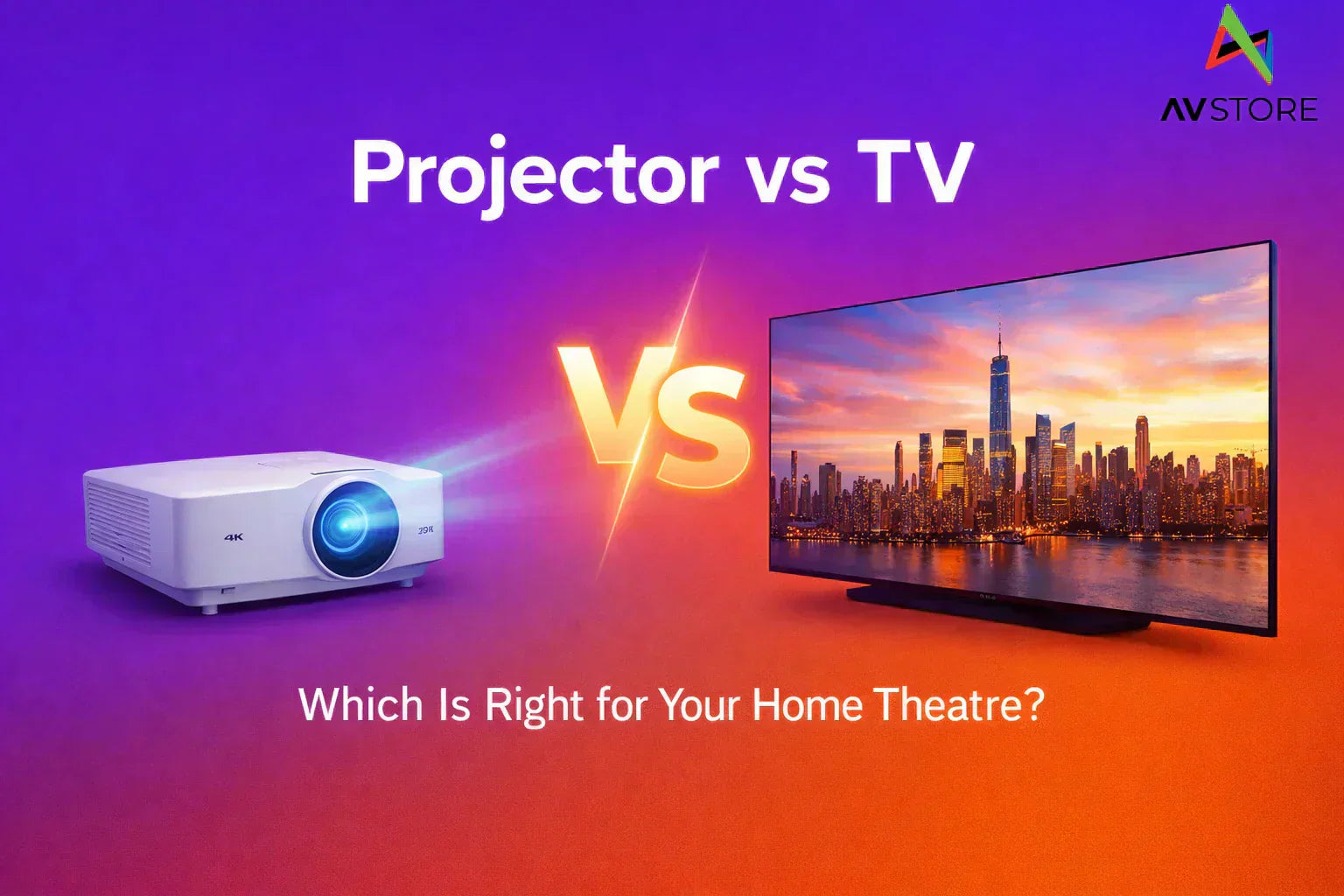
Scale changes everything. A 65-inch television is a screen. A 120-inch projected image is an event. The single most dramatic upgrade a living room can receive before the tournament begins is a projector-and-screen setup, and it is far more accessible than most buyers expect.
Why a projector makes sense for football specifically
Football is played on a large pitch, with twenty-two players and a ball constantly in motion. A large image makes the spatial relationships between players instantly readable: where the defense is positioned, where the space is opening up, what the goalkeeper is about to do. On a 120-inch screen, you read a football match differently than you do on a 55-inch one. That is not an exaggeration; it is geometry.
The specification to watch for in a projector used for sport is input lag, which is the delay in milliseconds between a video signal entering the projector and the image appearing on screen. For live sport, input lag below 50ms (milliseconds) is the acceptable threshold. Below 30ms is where you stop noticing it entirely. Most modern 4K projectors from BenQ, Epson, Optoma, LG, and XGIMI handle this well in their gaming or sports modes, but it is always worth confirming before purchase.
4K versus Full HD: The Honest Answer
A 4K projector renders UHD resolution (3840 x 2160 pixels, four times the information of a Full HD image), delivering fine detail in every frame: individual blades of grass, the texture of a goalkeeper's gloves, the exact trajectory of a set piece. At screen sizes of 80 inches and above, this detail is genuinely visible and improves the experience of watching. At smaller sizes, a quality Full HD projector is completely honest value and should not be dismissed. The rule is simple: if you are going big, and the whole point of a projector is to go big, go 4K.
The screen is not optional
A projector aimed at a white wall is half a system. The difference between a white wall and a proper projection screen becomes apparent the first time you see them side by side: the screen delivers better contrast, more uniform brightness, and more accurate color because its surface is engineered specifically to work with projected light. Fixed-frame screens are the best performers because the fabric is held under permanent, even tension with no wrinkles, no sag, and no variation across the surface. They suit a dedicated media room or a living room wall where the screen is a permanent fixture. Manual screens make more sense when the projection wall serves other purposes during the day; they drop for the match and retract when the room returns to normal life. If the plan involves watching from a terrace or garden, outdoor screens built for weatherproof use are the right tool for the job.
A great projector on a great screen is not just an upgrade. It is the difference between watching the World Cup and attending it.
2. The Sound Foundation: Soundbars

Not every home has space for a full surround system. Not everyone wants to run speaker cables behind skirting boards or wall-mount multiple drivers. The soundbar, a single horizontal enclosure containing multiple speakers, amplification, and often sophisticated audio processing, solves this problem honestly. A good soundbar in the right position delivers wide stereo separation, clear commentary, and a convincing sense of space from one piece of hardware. For most Indian apartments and living rooms, this is the most practical place to start.
What Dolby Atmos actually means for a football match
Dolby Atmos is a spatial audio format, an audio technology that adds height and three-dimensional positioning to sound rather than the traditional flat front-left, center, front-right arrangement. In a stadium broadcast, this means crowd noise arrives from different directions and different heights simultaneously, instead of from a flat wall of sound in front of you. Premium soundbars like the Sonos Arc Ultra, Sonos Arc, and Devialet Dione use upward-firing drivers, speakers angled toward the ceiling that bounce sound off the surface to create overhead impressions, to produce this effect. It is not the same as physical ceiling speakers, but the improvement over standard stereo in a World Cup broadcast is real and immediate.
What to look for when choosing a soundbar for sport
Commentary clarity is the critical factor. A soundbar without a dedicated center channel driver, a speaker specifically engineered to reproduce the midrange frequencies where human voices sit, tends to blur commentary into the general mix when crowd noise is loud. The better soundbars in AVStore's soundbar collection address this with a discrete centre channel and DSP (Digital Signal Processing, the onboard computing that analyses and shapes the audio signal in real time) tuned for dialogue intelligibility. Pairing a premium soundbar with a wireless subwoofer from the same ecosystem, the Sonos Sub Gen 3 working alongside the Sonos Arc being the cleanest example, changes the physical character of the sound entirely.
The right soundbar will make you forget you are listening to a single piece of hardware. That is exactly what it should do.
3. The Full Stadium Experience: AV Receivers and Surround Sound
This is where the experience stops being impressive and starts being physical. A 5.1 surround system, five speakers placed around the room, and a dedicated subwoofer reproduce a football broadcast the way it was actually mixed: crowd noise behind the listener, commentary from the front center, and stadium chants moving left and right across the soundfield. It is a fundamentally different experience from a soundbar, and once you have sat inside a properly set-up surround system for a live match, the soundbar feels like a half-measure.
The AV receiver is the brain of the system
An AV receiver, the component that accepts audio and video inputs, decodes surround sound formats, amplifies the signal, and routes it to the correct speakers, determines whether a multi-speaker system reaches its potential or fights itself. For a FIFA 2026 setup, three specifications matter most. The first is HDMI 2.1, the latest HDMI standard, supporting 4K video passthrough at up to 120 frames per second and eARC (enhanced Audio Return Channel, a feature that sends high-quality audio from a television back to the receiver without a separate cable). The second is Dolby Atmos and DTS:X decoding, both spatial audio formats used in broadcast and streaming content. The third is room correction software.
Room correction is the most underappreciated technology in a modern AV receiver. Audyssey MultEQ (found in Denon and Marantz receivers) and YPAO (Yamaha's equivalent, found across the Yamaha AV receiver range) are calibration systems that measure how sound behaves in your specific room, including its reflections, resonances, and acoustic irregularities, and apply a correction that compensates for all of it. In a typical Indian living room with hard marble floors, parallel walls, and minimal soft furnishings, this calibration step transforms what the speakers are capable of. AVStore's AV receiver range covers Denon, Marantz, Yamaha, Onkyo, and Pioneer across entry and premium tiers, from around Rs. 30,000 for a capable entry-level model to Rs. 200,000 and above for flagship processors.
How to think about speaker placement
The front left and right speakers carry the majority of the audio content and deserve the most investment. Floor-standing speakers, tall, multi-driver enclosures that stand independently, deliver full-range sound with authority and suit rooms larger than approximately 15 by 12 feet. Bookshelf speakers are the right choice for smaller rooms or where space alongside the screen is limited. The centre speaker, positioned directly above or below the screen, handles commentary and dialogue and should be matched tonally to the front pair; a mismatched centre creates an audible inconsistency that trained ears notice within minutes. The surround speakers, placed to the left and right of the listening position, are where a football broadcast truly opens up: crowd noise arriving from behind the listener is the single detail that most convincingly creates the sensation of being inside a stadium.
When the final whistle blows and 60,000 people erupt behind your head, a full surround system explains itself completely.
4. Feel the Crowd: Subwoofers

A subwoofer is not an indulgence. It is the speaker responsible for every frequency below approximately 80 Hz: the physical thud of a goal kick, the pressure wave of a stadium full of people jumping simultaneously, and the deep bass undertone of a broadcast's stadium ambience. Without one, a system is reproducing roughly 30% less of the audible spectrum than the broadcast contains. Every system in this guide, soundbar or full surround, benefits from a dedicated subwoofer.
Sealed versus ported: Choosing the right design for sport
A sealed subwoofer operates in a completely enclosed cabinet, producing tight, controlled, accurate bass with excellent transient response, which is the ability to start and stop quickly, tracking the rapid changes in a live broadcast. A ported subwoofer has a tuned opening in the cabinet that extends low-frequency output further into the bass range and produces higher overall volume at the cost of some precision. For football, where crowd noise is sustained, massive, and physically overwhelming, the ported designs from SVS, REL, and Polk Audio typically produce the more dramatic and immersive experience. For a system used equally for music and sport, a sealed design is more accurate and ultimately more versatile. AVStore's subwoofer range covers both designs across entry level (from around Rs. 15,000) through to reference subwoofers well above Rs. 100,000.
Placement is half the performance
Corner placement amplifies a subwoofer's output through boundary reinforcement, the acoustic effect where reflective room surfaces increase perceived bass level. In a large room, this is useful. In a smaller apartment living room, it can produce an overwhelming, one-note bass that obscures rather than enhances the content. The starting point for most rooms is to position the subwoofer near the front speakers, off the wall by at least 20 to 30 cm. The receiver's room correction calibration will then adjust the output level and crossover frequency (the point at which bass is handed off from the main speakers to the subwoofer) to suit the specific room.
The subwoofer is the part of the system you feel before you consciously hear it. For a World Cup final, that is not a small thing.
5. The Outdoor Watch Party: Outdoor and Portable Speakers

Some of the best football viewing in India happens outside: on a building terrace, in an apartment complex courtyard, on a villa garden, or simply gathered on a balcony late at night when the air has cooled. Outdoor audio presents a physics challenge that indoor speakers cannot solve; there are no walls to reflect and build sound pressure, so the same speaker that fills a room confidently sounds thin and distant in open air. Outdoor audio requires more power, wider dispersion, which is the angle across which a speaker projects usable sound to the listener, and physical resilience.
Permanently installed outdoor speakers
AVStore's outdoor speaker range covers speakers built specifically for permanent outdoor installation, with enclosures rated to resist humidity, dust, temperature variation, and rain. These are mounted on walls, under eaves, or in ceilings and driven by a compact amplifier or AV receiver. For a villa garden or a building terrace that is a genuine entertainment space, permanently installed outdoor speakers deliver a quality that no portable solution can match, because they are positioned correctly and driven with adequate power. IP ratings, the international standard for measuring resistance to dust and water where a higher second number indicates greater water resistance, matter here. IP55 is the practical minimum for outdoor use in Indian weather conditions.
Portable Bluetooth speakers for flexible watching
For watch parties that move, such as a friend's roof, a park gathering, or a large group that does not have installed audio, a quality portable Bluetooth speaker delivers genuine performance without infrastructure. The Bang & Olufsen Beosound A1 2nd Gen is waterproof, packs unexpectedly powerful bass for its size, and handles outdoor use comfortably. The Marshall portable range suits groups who want higher output levels and a wider sound. Modern Bluetooth 5.0, the current wireless standard, is typically reliable up to 10 meters with negligible latency, and high-quality audio codecs like aptX HD bring the wireless listening experience considerably closer to a wired connection than the technology managed even three years ago. AVStore's portable and Bluetooth speaker range covers everything from compact one-handed speakers to larger units capable of filling a full terrace.
The outdoor watch party is an Indian institution. The right speaker system makes your terrace the one everyone wants to be at.
6. Whole Home Football: Multi-Room Audio
The FIFA World Cup runs for thirty-nine days. Matches are broadcast across multiple time zones, beginning in the early morning and running through to past midnight. Following the tournament without being anchored to a single room, with the ability to have commentary in the kitchen while making tea, in the bedroom while getting ready, and continuing on the terrace when the evening opens up, is what a multi-room audio system provides.
How multi-room audio works
A multi-room audio system connects speakers to the home Wi-Fi network rather than to Bluetooth, which removes the range limitation and allows audio to play in multiple rooms simultaneously, synchronized so that walking from one room to another produces no jump, no echo, and no delay. The speakers are controlled through a single app on any phone. Volume, source, grouping, and zone management all happen without a dedicated remote or a central control panel. For an Indian home, whether a 3BHK apartment or a larger independent house, this is a genuinely different way to live with audio.
The Sonos ecosystem at AVStore
Sonos is the most complete multi-room audio platform available in India and is well-supported in wireless multi-room speakers. The Sonos Era 100 handles bedrooms, kitchens, and secondary spaces convincingly. The Sonos Five is the right choice for living areas where audio quality matters alongside convenience. The Sonos Arc Ultra, used as the primary soundbar for the main viewing room, integrates into the same ecosystem, so a single app manages both the main system and every room speaker simultaneously. For the group stage and knockout rounds alike, this means commentary follows the household rather than pinning it to one room.
The investment extends beyond the tournament
A multi-room system put in place for FIFA 2026 becomes the household music system, the background audio for every evening, and the speaker infrastructure for every gathering that follows. Thinking about the purchase as a tournament upgrade undersells it. The World Cup is a reason to do something that improves daily life indefinitely.
When the semifinal goes to extra time and the kitchen still needs attending, a multi-room system means nothing is missed.
Bringing It All Together
The FIFA World Cup is thirty-nine days of football at its finest, and the quality of how you experience it is almost entirely determined by what you watch and listen on. The right order of priorities is this: start with the screen, because scale is the single most impactful upgrade and a projector-and-screen setup delivers it more effectively than any television at any equivalent size. Add audio next, a soundbar if the room is compact or the setup needs to stay simple, or a full AV receiver and surround system if the space supports it. A subwoofer is not optional regardless of which audio path you choose. Then build outward: outdoor speakers if the terrace is part of the plan and multi-room audio if the tournament needs to travel through the house with you.
Every product in this guide is available at AVStore.in, India's most trusted source for premium home theater and hi-fi equipment, with AVXellence as the authorized dealer for every brand referenced here and experience centers in Pune and Mumbai where any system can be heard before it is bought.
The best seat in the house is the one you build before the tournament starts.
FAQs
Q1. What screen size and format gives the best football viewing experience at home?
Ans: A 120-inch projected image on a proper projection screen delivers the most immersive experience, making spatial relationships between players instantly readable — far beyond what any standard television can offer.
Q2. Is a subwoofer necessary even with a good soundbar?
Ans: Yes. A subwoofer covers frequencies below 80Hz that a soundbar cannot reproduce, meaning without one you are missing roughly 30% of the broadcast's audible spectrum.
Q3. What input lag is acceptable in a projector for watching live sport?
Ans: Under 50ms is the acceptable threshold; under 30ms means you will not notice any delay at all. Always verify this in the projector's sports or gaming mode before purchasing.
Q4. Where can I see and hear these systems before buying?
Ans: AVXellence operates Experience Centers in both Pune and Mumbai, where every system in this guide can be auditioned in person before any purchase is made.

Leave a comment
All comments are moderated before being published.
This site is protected by hCaptcha and the hCaptcha Privacy Policy and Terms of Service apply.