
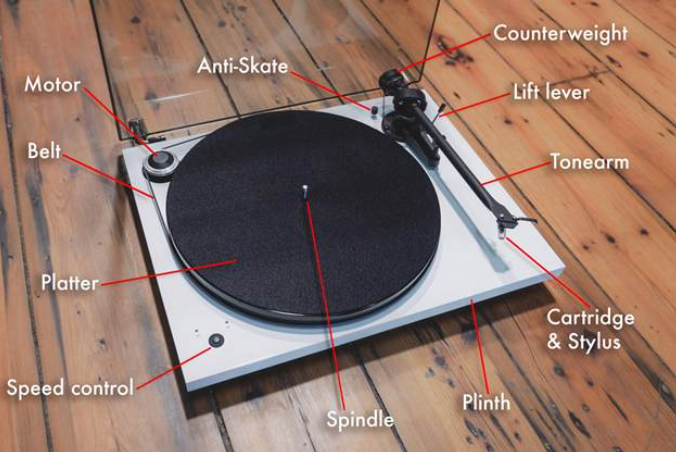
Whether you’re setting up your first turntable or fine-tuning a decades-old deck, understanding what each component does and how they interact is the difference between mediocre playback and truly immersive listening. This guide breaks down every major part of a record player, explains its role in the signal chain, and offers practical tips for getting the best performance out of your setup.
1. The Plinth (Base)
The plinth is the chassis of your turntable; everything mounts to it. It’s typically made from MDF, solid wood, acrylic, or a combination of materials chosen for their vibration-damping properties. A well-designed plinth isolates the delicate playback mechanism from external vibrations that would otherwise colour the sound.
Budget turntables often use lightweight plastic plinths, which resonate easily and allow motor noise to creep into the signal path. If you’re upgrading, a heavier, denser plinth is one of the most impactful changes you can make.
Isolation Feet
Mounted at the base corners, isolation feet decouple the turntable from the surface it sits on. They’re usually made of rubber, sorbothane, or spring-loaded mechanisms. Proper isolation is critical; footsteps, speaker vibrations, and even traffic rumble can feed back through the stylus and degrade playback. Audiophile setups sometimes replace stock feet with aftermarket isolation platforms for even better decoupling.
2. The Platter & Drive System
Platter
The platter is the heavy rotating disc on which the record sits. It’s driven by a motor and its mass serves as a flywheel, smoothing out speed variations. Platters are made from aluminium, acrylic, glass, or steel, each material imparting different resonance characteristics. Heavier platters generally provide more stable rotation, which translates to lower wow and flutter (micro speed variations audible as pitch wavering).
Slipmat
Sitting between the platter and the vinyl, the slipmat provides a friction surface and further vibration damping. Felt is the most common material, but cork, rubber, and leather mats each offer different sonic signatures. Cork tends to reduce static buildup, rubber provides excellent damping, and leather offers a balance of both.
Spindle
The spindle is the small metal pin protruding from the platter’s centre. It serves as the locating point for the record’s centre hole, keeping the disc properly aligned during playback. Some spindles are threaded to accept a record clamp or weight, which presses the vinyl flat against the mat for better contact and reduced resonance.
Drive Types
How the motor connects to the platter defines the turntable’s drive type. Belt-drive tables use an elastomeric belt stretched between the motor pulley and the platter or the sub-platter, isolating motor vibrations effectively. This makes them the go-to choice for critical listening.
Direct-drive tables mount the platter directly on the motor shaft, offering higher torque and speed stability essential for DJ use. Idler-wheel drives, common in vintage units, use a rubber wheel pressed against the platter’s inner rim; they deliver strong torque but are more prone to rumble.
3. The Tonearm Assembly
The tonearm is arguably the most mechanically complex part of a turntable. Its job is deceptively simple: hold the cartridge at the correct angle and tracking force while allowing it to follow the record’s spiral groove with minimal friction. In practice, achieving this requires careful engineering.
Tonearm Tube
The arm itself is a tapered or straight tube, typically aluminium, carbon fibre, or wood. Its job is to be as rigid and non-resonant as possible while remaining light. The effective mass of the arm how much inertia it presents to the cartridge, must be matched to the cartridge’s compliance (its suspension stiffness) for optimal tracking.
Headshell
The headshell is the mounting platform at the tonearm’s business end. On many turntables, it’s detachable, connecting via a standardised bayonet fitting, which makes cartridge swapping convenient. The headshell’s mass contributes to the tonearm’s effective mass, so material choice matters. Aluminium is standard; magnesium and carbon-fibre options shave grams for low-mass arm configurations.
Cartridge & Stylus
This is where the magic happens. The cartridge houses a tiny generator, either a moving magnet (MM) or a moving coil (MC), that converts the stylus’s mechanical vibrations into an electrical signal. The stylus (needle) is a precisely shaped diamond tip that rides in the record’s groove at a contact area measured in microns.
MC cartridges generally offer superior transient response and detail retrieval but require a dedicated phono stage with higher gain. MM cartridges are more affordable, user-replaceable, and pair with any standard phono preamplifier.
Counterweight
Mounted at the rear of the tonearm, the counterweight is a precisely calibrated mass that balances the arm and sets the vertical tracking force (VTF). Correct VTF is critical: too light and the stylus skips or mistracks; too heavy and it accelerates groove and stylus wear. Most cartridges specify an optimal range, typically between 1.5g and 2.5g (as per company specifications). A digital stylus force gauge is the most accurate way to set this.
Anti-Skate
As the stylus rides a spinning groove, friction creates an inward-pulling force called the skating force. The anti-skate mechanism applies an equal and opposite outward bias—usually via a spring, hanging weight, or magnetic repulsion to keep the stylus centred in the groove. Proper anti-skate reduces distortion and ensures even wear on both groove walls.
Cueing Lever
The cueing lever (or tonearm lift) raises and lowers the tonearm with damped, controlled motion. This prevents the stylus from dropping onto the record surface abruptly, which could damage both the groove and the tip. Hydraulically damped cueing mechanisms provide the smoothest descent. Always use the cueing lever rather than dropping the arm by hand.
4. Motor & Speed Control
The motor drives the platter at a constant speed. Consumer turntables typically support 33⅓ RPM and 45 RPM, with some also offering 78 RPM for shellac records.
The speed selector switch toggles between these speeds, often by changing the motor pulley diameter (belt-drive) or the motor’s drive signal (direct-drive). Quartz-locked direct-drive tables offer the highest speed accuracy, maintaining deviation well below 0.1%.
5. Dust Cover & Hinge
The dust cover is a clear acrylic or plastic lid that protects the platter, record, and stylus from dust and accidental contact. It attaches to the plinth via hinges at the rear. An important but often overlooked detail: most manufacturers recommend playing records with the dust cover open or removed entirely, because a closed cover can act as a resonant surface, picking up airborne vibrations and feeding them back through the tonearm.
6. Power Switch & Electronics
The power switch controls the motor. On basic decks, it’s a simple on/off toggle; on more advanced models, electronic soft-start circuits gradually bring the platter up to speed, reducing belt stress and motor wear. Some high-end turntables use outboard power supplies to keep electrical noise away from the sensitive audio signal path.
7. The Phono Stage (Preamp)
While not always built into the turntable itself, the phono stage is an essential part of the playback chain. Records are cut with RIAA equalisation, bass frequencies are attenuated, and treble frequencies are boosted during mastering. The phono preamp applies an inverse RIAA curve to restore flat frequency response and preamplifies the cartridge’s tiny output to line level. Many entry-level turntables include a built-in phono stage that can be bypassed once you upgrade to an external unit.
Bringing It All Together
- Every component in a turntable contributes to the final sound.
- The plinth and feet isolate the system; the motor and platter provide stable rotation.
- The tonearm positions the cartridge precisely
- The cartridge and stylus extract the signal from the groove.
- and the phono stage conditions that signal for amplification.
- Weak links anywhere in this chain compromise the whole system.
For enthusiasts looking to upgrade, focus on the cartridge and stylus first. This is where you’ll hear the biggest difference per rupee spent. Next, address isolation (feet, placement surface, plinth material). Then look at tonearm upgrades or a better phono stage. And throughout it all, keep your records clean and your stylus debris-free.
Keep in mind that the best turntable in the world can’t make a dirty record sound good.



Leave a comment
All comments are moderated before being published.
This site is protected by hCaptcha and the hCaptcha Privacy Policy and Terms of Service apply.